

New Progress in Late Miocene Rapid Exhumation in West Kunlun, India-Asia Collision Timing, and Tibetan Plateau Growth Mechanisms
Publisher:
time: 2025-12-31
The uplift and growth process of the Tibetan Plateau is a core scientific question in earth sciences. It is generally believed that the Tibetan Plateau and the Indian Craton underwent surface suturing in the southern Lhasa region. However, deep geophysical observations reveal that the Indian lithosphere is subducting northward at a near-horizontal angle, with its leading-edge extending hundreds of kilometers beneath the plateau. Receiver function studies further confirm that the western front of the Indian slab has reached beneath the West Kunlun. This deep subduction process is key to driving Cenozoic orogeny in the northwestern margin of the Tibetan Plateau, yet how surface deformation responds to these deep dynamic processes remains a focus of academic debate.
Upon that, the team led by CAS Academician Xiao Wenjiao conducted systematic low-temperature thermochronology studies on the West Kunlun orogenic belt. They identified two episodes of rapid uplift in the Late Miocene, occurring approximately 11–10 Ma and 7–6 Ma, respectively. These events reveal significant crustal shortening and episodic uplift in the northwestern Tibetan Plateau during the Late Miocene, revising previous views that underestimated tectonic activity during this period.
The study shows that the rapid uplift around 11–10 Ma corresponds to the initial "hard collision" between the Indian and Tarim plates. This event led to a significant slowdown and stabilization of the India-Eurasia plate convergence rate after ~11 Ma. It also triggered (ultra-)potassic magmatism in the West Kunlun region by ≤10 Ma and a widespread uplift response recorded around ~11 Ma across the Tibetan Plateau and surrounding orogens (e.g., Tianshan). Notably, since the Oligocene, cooling ages and (ultra-)potassic magmatism ages show a trend of becoming younger from the interior of the plateau (Qiangtang-Lhasa terranes) towards the West Kunlun. This spatiotemporal pattern is controlled by the deep dynamic process of the continuous northward indentation of the Indian plate into Asia. The subduction, collision, and subsequent tearing of the Indian slab collectively regulate the "outward growth" of the plateau and "magma migration." The research findings have been published in Geology.
The research was supported by CPJRC.
Paper link: https://doi.org/10.1130/G53642.1
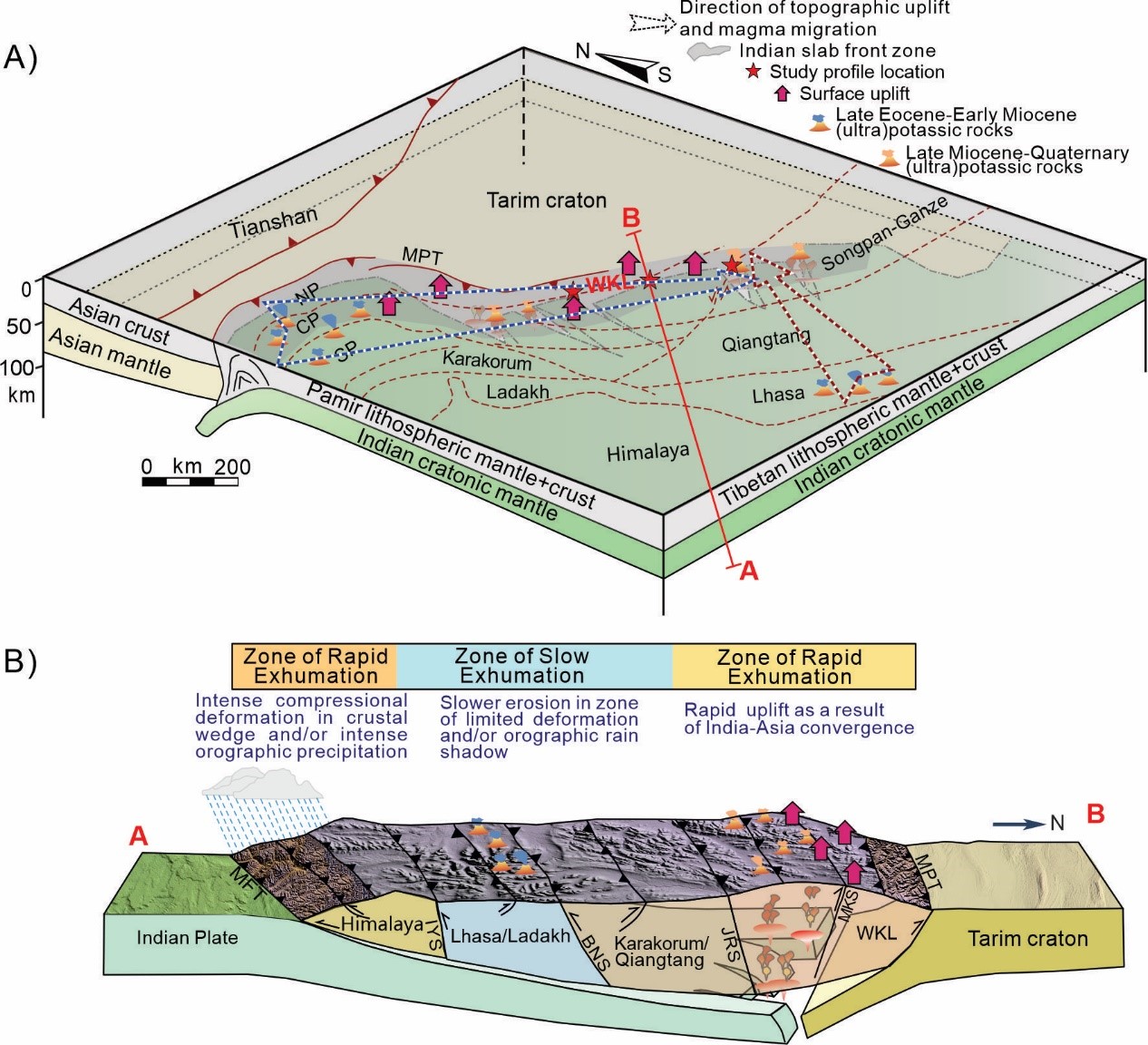
Schematic Diagram of Deep-Shallow Coupling During the ~11 Ma India-Asia "Hard Collision"



